Showing posts with label Facebook. Show all posts

Thursday, July 26, 2012

Small Retailers Open Up Storefronts on Facebook Pages

The pattern found with blogshop businesses on blogs and Facebook can be found in other parts of the world, especially with Facebook.  Although the use of blogs as improvised online retail platforms was never established outside of SE Asia, it appears that small businesses have jumped on Facebook.  This process of using social networking as the basis for business is a universal one.


From: http://www.nytimes.com/2012/07/26/business/smallbusiness/small-businesses-win-customers-on-facebook.html?_r=1

July 25, 2012

Small Retailers Open Up Storefronts on Facebook Pages

When Mandie Miller left her job as an on-air traffic reporter in Charlotte, N.C., to have her first child, she started baking cakes for friends, just for fun. The response was so positive that in April 2009 she started a business, Got What It Cakes.
Ms. Miller put up a Web site, but about five months later her sister created a Got What It Cakes Facebook page. That’s when the business started to grow. Cake orders went from two or three a weekend to six to 10; now Ms. Miller is turning away another 10 each weekend. Annual revenue at the end of her second year in business was a little more than $40,000.
Got What It Cakes is part of a new wave of online commerce: F-commerce. Social media specialists say the term was coined in 2009 to describe the growing number of businesses that sell through a Facebook page. Payvment, a start-up that provides support for Facebook shopping transactions, says it has 170,000 clients and is signing on about 1,500 stores a week, most with fewer than five employees.
The rise of F-commerce has been largely haphazard, something Facebook did not instigate or promote. A spokesman declined to discuss the phenomenon, except to acknowledge, “Retailers are experimenting in a number of ways.”
Small businesses seem to be having more success on Facebook than large companies, said Sucharita Mulpuru, a retail analyst at Forrester. Those doing well, she said, generally have less than $100,000 in revenue and fewer than 10 employees. Gap, Nordstrom, J. C. Penney and GameStop, on the other hand, have all shut down Facebook stores in the last 12 months, mostly, Ms. Mulpuru said, because consumers are accustomed to the richer experience on retailing Web sites.
But Facebook can present challenges to businesses of all sizes. Some consumers do not feel safe buying directly from a Facebook storefront, said Krista Garcia, a social commerce analyst with a market research firm, eMarketer. And business owners should be aware that they do not own their Facebook pages — Facebook does, and it can change the appearance and rules whenever it wants. 

GETTING STARTED 
It’s easy for a small business to open a Facebook storefront by creating a page in the business’s name, loading photos of the product and adding shopping functions. Because Facebook storefronts can look generic, small businesses have to find ways to differentiate themselves, said Jay Bean, chief executive of an online marketing firm, OrangeSoda.
Customizing a page is done by installing applications that enable customers to do things like shop, enter contests or see a menu. Apps are available from Facebook and outside vendors, or they can be custom-developed.
Payvment’s tools let businesses create a storefront with a shopping cart and promotions like discounts and coupons. 

USE YOUR PERSONALITY 
Unlike larger businesses, small businesses can build on their personal relationships to end users, said Wendy Tan-White, chief executive of Moonfruit, which builds and supports e-commerce Web sites. She advises using a cover image for a business’s page that relates not only to the product or service but to customers, too.
On the Got What It Cakes storefront, for example, the cover photo shows the owner, Ms. Miller, in her home, with baby photos on the wall behind her and several cakes scattered about the sitting room; the smaller-profile photo is the company logo.
Many of Ms. Miller’s customers are busy mothers like her, and she communicates frequently with them on Facebook. “I am a local, one-person business but I have 5,000 fans,” she said.
Ms. Miller gives the kinds of tips her customers might get from a friend, like what to do with leftover chocolate cake batter: “Put some butter on your griddle and make pancakes with it.” 

POST, PIN AND TAG 
To attract fans and friends, a storefront needs to be dynamic, with frequent posts — status updates and photos. Tagging people in a photo may cause the photo to show up on the tagged person’s page, where friends (and often friends’ friends) can see it.
Deann Kump, founder of TuTu Cute, which sells hair accessories and clothing for mothers, babies and toddlers, hosts a monthly photo contest on her page.
“If someone posts a photo of their daughter wearing one of my products and tags it, their friends will wonder, ‘What is TuTu Cute?’ and go to my page,” she said.
Mrs. Kump opened on Facebook last December and about half of her sales occur on the site.
Ms. Tan-White of Moonfruit suggested that a business give customers incentives to spread the word, offering a discount if they tag its product in a photo. Facebook’s “pin” feature allows users to pin a post, which might be a product of the week or a special discount and pushes the post to the top of a business’s page. 

FOCUS ON COMMUNITY  
Magical Moments Modeling made TuTu Cute a “boutique of the month” on its Facebook page in April so friends of both pages could see it. And Mrs. Kump often promotes the work of children’s photographers she likes; they in turn promote her accessories.
Patrick Skoff, a painter who sells 90 percent of his paintings on Facebook, said some visitors to his page might have been hesitant about buying until they saw the comments and “likes” on new and sold paintings.
“They see all the likes and think, ‘Oh, I better buy that before someone else does,’ ” Mr. Skoff said.
In July he painted 10 paintings a day for 10 days and sold all of them through Facebook.
Darren Gann, co-owner of the Baby Grocery Store, started his Facebook storefront in February (he also has a kiosk in SouthPark Mall in Charlotte). Thirty-five percent of his sales come through Facebook, and Mr. Gann gives lots of help and advice to his customers. “They communicate with us there about everything, from asking about a shipment to what do we recommend for a gluten-free 9-month-old."
Heather Logrippo opened a Facebook storefront in 2009 for We’ve Labels, which sells clothing labels. She routinely goes to the Facebook pages where her customers spend time, like those for quilters or knitters.
“I log on as We’ve Labels and start interacting with people, writing things like: ‘That’s a beautiful scarf you’ve knitted,’ ” she said. Those knitters and quilters will often click on the We’ve Labels page out of curiosity. 

OFFER OPTIONS 
While some small businesses sell only through Facebook, others maintain separate Web sites or have bricks-and-mortar outlets, because not all consumers feel comfortable using their credit card information on the site.
Ashley Gall, owner of Méli Jewelry, which sells jewelry she designs and makes, said buying on Facebook was still too new for many of her customers — 15 percent of her sales happen there — so she also sells on Etsy, Indie Fashion Marketplace and her own Web site.
Most of Mandie Miller’s customers order on Facebook and pay when she delivers the cake or when they pick it up. Yet she still maintains a Web site of her own.
“I do a lot of wedding cakes, and it’s the moms and dads of brides usually paying and they often want to go to a regular business Web site. I also have grandmothers in their 80s and 90s that come to my cake tastings,” she said. “They aren’t on Facebook.” 

This article has been revised to reflect the following correction:
Correction: July 25, 2012

Monday, January 30, 2012

F-Commerce- the Storefront of the Future

From: http://www.virtualarchitects.co.za/blog-categories/item/99-f-commerce-the-storefront-of-the-future


F-Commerce Logo
F-Commerce is a new word that will be gaining a lot of momentum in the next few months as Facebook commerce or online stores embedded within Facebook become more popular and widespread due to improvements in online shopping functionalities.
So the game is changing!...and it has major implications for retailers and how they continue to market and sell their products and there are now applications that are getting closer to the "social business nirvana" of being able to have stores within Facebook that keep you totally within Facebook's ecosystem and that technology is closer than you think. There will even be the ability for cross-store shopping carts turning the whole of the Facebook brand platform into one big store. woolies-fcommerce
F-Commerce will become another online channel for businesses to sell products and services with all the marketing power that Facebook provides. Facebook's ecosystem evolution is naturally extending to online shopping where you can buy your favourite brand's products and services while using Facebook. This integration with Facebook provides approximately 50% of their online sales and is proving to be as effective as e-mail marketing!
This will enable Facebook to be the setting for the entire consumer buying cycle from pre-purchase research to marketing (Facebook ads & social media marketing) and consumer engagement. This now extends right through the purchase process and even post-purchase engagement. This is particularly good news for small businesses as they can now promote their brand, engage with their consumers and retail the goods all in the same place and on the same platform.
Adding e-commerce functionality to Facebook will help marketers prove how closely social media can be tied to sales, and will also help Facebook's primary revenue strategy, advertising, by enabling advertisers to monetize campaigns directly with e-commerce sales.
f-commerce-ecosphere-blog-full
Some points for the use of F-Commerce are:
  • 800 million users on Facebook
  • Average of 130 friends each to share your latest shopping experiences especially how much you have saved
  • 14 minutes per day on-site (the average total time on Facebook now exceeds Google)
  • 40% of people use social networking sites when shopping online
  • 68% of fans visit retailer pages to keep up to date with sales and promotions
  • Fans are 41% more likely to recommend a product
  • Heavy social networkers aged 11-14 are 65% more likely to buy clothes online, 40% more likely to buy books online and 20% more likely to purchase music downloads
  • For some businesses 20% of sales are through their Facebook store
  • Cart values are 7-10% higher via Facebook
Here are great resources with case studies and examples of Social Selling Success Stories:
http://barnraisersllc.com/2011/07/34-case-studies-prove-social-commerce-roi
http://econsultancy.com/us/blog/7540-101-f-commerce-examples
Facebook is making these new functionalities available to brands and marketers through a new Facebook Fan Page Toolkit. The soon to be announced kit will provide 3 Facebook apps that allow the set up and implementation of a Facebook store easily.
Fanpage App:
• Design and set up your Fanpage Facebook store front window to compliment your brand.
Promotion App:
• Promote your store by allowing importing of emails and integrating Twitter and Facebook messaging to take full advantage of Facebook and social media's marketing leverage.
F-Commerce App:
• Setup your store with products and images with many features and functions including inbuilt analytics, which will assist you in making changes to your marketing tactics so that you can improve your stores performance.
Here is a sample screen shot of what is coming.
F-Commerce screen shot
                           Here is an Infographic that Explains the History of F-Commerce
715-fcommerce-infographic
Resources:
http://www.jeffbullas.com/2011/03/07/f-commerce-is-facebook-the-new-shop-of-the-future/
http://socialcommercetoday.com/adage-on-social-commerce-f-commerce-is-here/
http://www.jeffbullas.com/2011/03/10/f-commerce-10-tips-for-a-successful-facebook-store/
http://barnraisersllc.com/2011/07/34-case-studies-prove-social-commerce-roi/
http://econsultancy.com/us/blog/7540-101-f-commerce-examples

Monday, December 26, 2011

Facebook fails to deliver on 'social shopping' this holiday season

From: http://www.theglobeandmail.com/news/technology/tech-news/facebook-fails-to-deliver-on-social-shopping-this-holiday-season/article2282045/

Facebook fails to deliver on 'social shopping' this holiday season

New York, San Francisco— Financial Times
Even as U.S. Christmas shoppers have spent a record number of dollars online this year, one of the biggest disappointments for some internet entrepreneurs has been a company that is otherwise hot property: Facebook.
Retail executives and consultants say Facebook has yet to take off as a retail platform, defying excited predictions that “social commerce” – jargon for shopping via social media sites – would be the next big thing.
Jonathan Johnson, president of Overstock.com, an online retailer, says: “I agree that the commercial aspect of social media is over-hyped and no one’s really caught that rabbit yet.”
Skeptics say social commerce was a rhetorical fad inflated by Silicon Valley self-belief. Advocates say it’s merely in its infancy and that someone will soon find the right combination of technology and temptation to make it work.
They have slapped the vague term “f-commerce” on the potential crossover between Facebook and shopping, but as retailers’ experiment with it, their options fall into three broad categories.
First, they can use Facebook as an advertising tool to draw customers to their own websites. Second, they can use it to gather data about shoppers and recommend products based on Facebook interests – as Overstock.com and Walmart’s Shopycat service are doing for gifts. Third, they can set up fully-functioning stores inside Facebook.
However, Kevin Ryan, chief executive of Gilt Groupe, an online fashion retailer, says there is less commerce on Facebook than many people had anticipated just nine months ago.
“It’s an extraordinary place where people go and connect with their friends,” he says. But “to date, they are not using it really to make concrete purchasing decisions and they are certainly not purchasing things on Facebook”.
On Cyber Monday, a post-Thanksgiving shopping day in the U.S. when retailers offer big online discounts, just 0.56 per cent of buyers were referred from social networks, according to IBM.
Facebook itself, which is due to float on the stock market in 2012, shows no interest in being a retailer. It is focused on advertising.
But it says 88 per cent of the top 200 internet retailers are “integrated” with its site and have seen traffic from Facebook increase by an average of 236 per cent from the holiday season last year.
Joel Bines, a retail consultant at AlixPartners, is skeptical: “It feels like flavour-of-the-moment ... It’s [growing] off a tiny base and very soon it’ll revert to the mean and be just another way of marketing to people.”
Only a few retailers have created genuine stores within Facebook, including Aéropostale, a U.S. teen clothes retailer; Asos, a UK online fashion store; and 1-800-Flowers.com.
Against a backdrop of privacy concerns, Jason Taylor of Usablenet, a software company that sets up such stores, says retailers run them off their own systems and do not share sensitive financial data with Facebook.
The theory behind f-commerce was that young people who spent hours on Facebook wanted as much of their lives to be there as possible – including shopping.
But there’s a hitch. “Consumers today are not looking at Facebook psychologically as a place where you go to buy things,” says Mr. Ryan of Gilt.
Mr. Taylor agrees: “When people are on Facebook they’re in sharing mode, not purchase mode. So the measure for success is not revenue through Facebook. It’s sharing of the brand and traffic.”
Facebook itself wants to draw advertisers’ attention to how its site can inspire shopping ideas – even though it’s impossible to pin down a causal link between, for example, one person clicking the “like” button on a Tiffany & Co. ring and a friend who noticed and a month later bought a Tiffany necklace.
Booz & Co., the consultancy, forecasts that social commerce in the U.S. will grow from $1-billion this year to $14-billion in 2015, but it uses a loose definition that includes purchases influenced by Facebook and product buys on daily deal sites such as Groupon.
Mr. Johnson of Overstock.com says: “We’re not trying to use it as a sales piece as much as an information-gathering piece. Finding out what our customers want; whether they like a product; how could we sell it better.”
Siva Kumar, chief executive of TheFind, said data gleaned from Facebook’s like button had helped him improve online searches by highlighting the most-liked products on the web.
While he acknowledged that social commerce overall hasn’t been very successful so far, he updated the optimistic forecast heard from others at the end of last year: “I expect 2012 is really the year that social commerce is going to take off … It’s like walk, crawl, run. The running should happen next year.”

Friday, November 18, 2011

E-commerce's Next Wave: How Your Facebook Wall Could Become an Online Mall


From: http://www.dailyfinance.com/2011/11/17/e-commerces-next-wave-how-your-facebook-wall-could-become-a-on/


E-commerce's Next Wave: How Your Facebook Wall Could Become an Online Mall

Posted 9:40AM 11/17/11 Technology, Wal-Mart Stores, Facebook, Retail
 
 
Ah, the social phenomenon that is Facebook: It's where you banter with "friends," share vacation photos and "like" everything from your favorite classic sitcom or candy bar to your preferred political party -- so why not shop there, too?

Retailers are making it easier to do just that.

Chains such as Express (EXPR) and 7 For All Mankind now sell directly on Facebook, just as Walmart (WMT) is bringing its stores to life on the site, reaching out to consumers where they spend their virtual lives.

Retailers had already been racking up Facebook "fans" to build brand loyalty, establish a sense of community, spread the word about sales and events, and spark chatter about their merchandise -- so selling on the site is the next logical step.

It's not surprising, says John Squire, chief strategy officer with IBM Coremetrics, IBM's (IBM) marketing technology company.

According to October conversion rates, 9.2% of consumers who visited a retail site from a social media site made a purchase, Coremetrics' data showed. And Facebook accounted for an estimated 77% of all traffic from social networks, Squire says. "If you want to get new products discovered, this seems like a very good place."

Express Takes on F-Commerce

Retailers are banking on the premise that shopping on Facebook will appeal to consumers who don't want to pry themselves away from the social network.

Express made everything in its stores available for purchase on Facebook in April. Inventory gets updated in real time, and shoppers can pay without leaving the site. The apparel merchant, which has more than 600 stores, has a captive audience on Facebook, Lisa Gavales, chief marketing officer of Express, tells DailyFinance.

"It was very much about being where our customers were, and if they were in the mood to shop, they'd be able to do it very easily, on the site, multiple times a day," she says.

The difference between shopping on Facebook and the Express' e-commerce site is the social nature of the transaction, Gavales says. When a shopper has just purchased a striped lace T-shirt, for example, she can highlight that purchase on her Facebook wall for all her friends to see.

The social shopping model meshes with the habits of Express' target demographic, which has come of age sharing their private lives in public online spaces like Facebook, Twitter and Foursquare. "Our customer is 25, and she likes to get and give advice to her friends. It offers an opportunity to show what she likes, and what she thinks is attractive and fashionable," Gavales says.

Indeed, Facebook fans may unwittingly serve as brand evangelists. A thumbs up on that cool Express top from a Facebook friend, for example, holds more weight than a store advertisement or promotion, experts say. Taken to the extreme, "digital influentials," people whose opinions hold outsized sway on social networks, can boost -- or dampen -- sales based on their reviews.

Facebook commerce also offers instant insight about what's selling -- data Express can use to tailor its merchandise mix, Gavales says. "We know a little more quickly what will become a hit based on the 'likes' we're getting."

Fan-Generated 'Stores'

Like Express, upscale denim retailer 7 For All Mankind invested in Facebook commerce because for many people, the site has become an extension of themselves, says Barry Miguel, president of the chain.

"Instead of asking our fans to come to us at 7forallmankind.com, we are going where our fans are -- on Facebook," he says.

Seven For All Mankind's F-commerce page serves up an edited mix of the brand's collection, and is designed to make its fans feel like insiders. Sale items are exclusive to fans for two days before they show up on the chain's own e-commerce site.

But what's most unusual about 7 for All Mankind's F-commerce platform is a new feature that enables shoppers to buy products from a News Feed Store on their Facebook wall. Facebook fans can create wish lists to share with friends, which become personalized stores in the news feed.

Social commerce experts call the Facebook news feed the most valuable real estate in the digital space, akin to having an anchor store in an "A" mall. "The majority of the time spent on Facebook is spent on the news feed, so we felt that was an important component in our F-commerce efforts," Miguel says. "There is a viral component to the [news feed stores] that extends the reach of our brand message beyond people who are existing fans of the brand."

F-Commerce, Magazine Style

Urban Outfitters (URBN), too, set out to make its catalog shoppable on Facebook.

With the help of enter: new media, it launched a "magalog" on Facebook in August to tout its fall merchandise, the first of its kind, according to Curtis, the agency's president. Facebook fans can virtually flip through pages of glossy photo spreads and editorial content, roll over a picture of an item and pull up a product description. To make a purchase, users are directed to Urban Outfitters' e-commerce site.

The approach builds on the marriage of content and commerce, a trend bubbling up with new sites like Cladmen.com, an online menswear shop that features advice and product information from the editors of Esquire magazine, and gourmet food site Gilt Taste, which includes articles for foodies, and lush photography to help sell upscale culinary fare.

The retailer will soon launch its holiday magalog, Curtis says. Urban Outfitters declined to comment for this story.

Facebook Selling or Facebook Marketing?

Facebook's role as a retail venue is still a moving target. But Jeffrey Grau, a retail analyst with eMarketer, a digital trend analysis firm, bets that Walmart's "Facebook marketing" approach will resonate more with shoppers over the long term than selling directly on the site. "That's the real opportunity," he says.
In October, the world's largest retailer launched more than 3,500 store-specific Facebook pages. The new MyLocal Walmart Facebook app enables shoppers to track what's in the stores near them, offers locally relevant information on new products, and updates on discounts.

"Facebook is a treasure trove of personal information and consumer information, and retailers are finding out ways to leverage that, send people targeted offers, and even drive them to their stores," Grau says. Indeed, "Despite the wild success of e-commerce, 94% of all purchases are done in stores."

But it's not only traditional brick-and-mortar retailers that are experimenting with selling on Facebook -- the entertainment world is too, says Blair Heavey, CEO of Moontoast, which distributes social commerce platforms for artists such as Jay-Z, Rascal Flatts, as well as Sony Music Entertainment and the American Music Channel.

The company launched a store on Facebook last year to help pre-sell Reba McEntire's album, All the Women I Am, pushing items such as lithographs signed by the country singer, as well as apparel and concert tickets, and offering special rewards for fans.

Product sales from the Facebook McEntire shop outperformed other venues, Heavey says. "Entertainers can take advantage of impulse purchases by rewarding fans who have publicly declared they 'like' them through differentiated offers delivered socially," he says.

Thursday, November 17, 2011

PayPal Launches Facebook App for Sending Money to Friends

Payment is a thorn in the side for blogshops and Facebook stores which typically do not utilize automated payment systems like Paypal to afcilitate transactions.

This has given rise to credibility issues, that is the inadequacy of the platform to process e-commerce transactions.

With this new app, however, it might make social commerce more convenient for sellers and buyers.  I think this represents a step toward credibilizing social commerce.  In other words, instead of blogshop/FB store owners having to move to a more 'legitimate' EC platfiorm like a shopping cart to gain credibility, social media is becoming more credible as an EC platform with facilitites like this.

The other question, of course, is whether users in this part of the world will adopt this or other apps like this one.

From: http://mashable.com/2011/11/17/paypal-facebook-send-money/#view_as_one_page-gallery_box3137


Social payments are taking a giant leap forward. PayPal has unveiled a Facebook app that lets you send money to friends.


The app, simply titled Send Money, is just as straightforward as its name. You have the choice to send either an ecard with money or just money with no card. You select a card, choose a friend to send it to and then select how much money to send.

“The PayPal and Facebook infrastructure have now merged,” PayPal’s Anuj Nayar says. “This is another way to personalize the act of giving money.”

While there are several ways to pay with PayPal via Facebook (Payvment comes to mind), this is the first app to enable peer-to-peer payments via Facebook and PayPal. And because it’s a peer-to-peer transaction, there is no transaction fee, though PayPal’s regular limits and international fees still apply.

“Sending money, person to person, is free,” PayPal Senior Product Marketing Manager JB Coutinho said. “If it’s funded by a PayPal balance or linked to a bank account, it’s free.”

And while the primary aspect of the Send Money app is its enablement of transactions across the world’s largest social network, the ecard aspect is being emphasized as well. PayPal was quick to point out that more than 500 million ecards are sent every year, and that’s why PayPal is offering dozens of choices for everything from birthdays to congratulations.

We can see the app really taking off. Users who see on Facebook that it’s a friend’s birthday can quickly fire up the app and send a card and some cash within a few minutes. The app is just as useful for things like lottery pools and reimbursing friends for lunch. It’s a big step toward making social payments a reality.

If you want to learn more about the PayPal Send Money Facebook App, we’ve created a simple walkthrough of the payment process. Check it out in the gallery below, and let us know what you think of the app in the comments.

Tuesday, June 28, 2011

Attention Facebook Shoppers: Get Ready For F-Commerce

In tandem with yesterday's post, this article further shows how socially oriented Web commerce (Facebook stores, blogshops, etc) is different than older and more 'mainstream' dotcom or e-commerce stores.

In addition to the Social Web being more personal and relationships oriented, there should be more focus on interaction and engagement as explained in this article.

In terms of those 'Facebook blogshops', we see that many of them do not understand this, as they use Facebook very much like they would use an older media like email in that they would incessantly 'spam' the walls of their friends or fans.  There are, however, a handful of owners who are trying hard to engage people on Facebook, like S + S who are doing similar things as what is being described in this article.

Social commerce is emerging and the people who are trying to make use of it do not necessarily know how best to use it.

From: http://blogs.forbes.com/ciocentral/2011/06/27/attention-facebook-shoppers-get-ready-for-f-commerce/

Attention Facebook Shoppers: Get Ready For F-Commerce

Jun. 27 2011 
Written by Tim McMullen
Tim McMullen: Shopping Facebook.

Ready or not, we’re approaching the age of F-commerce: Facebook-based retailing.

It’s time for retailers around the world to prepare for the rise of the Facebook consumer, a new breed in convenience-seeking online shoppers. From shoes to plane tickets, it’s all right there on the social network.

Facebook now offers options for retailers to tailor their Facebook page layout to look less like the familiar profile page and more like a Web page. The simple click-and-pay option seems to be attracting more shoppers. And where shoppers flock, retailers follow.

One thing in particular that’s encouraging businesses to participate in F-commerce is the fact that the platform is completely free. There are no hosting or domain fees (yet), and Facebook isn’t keeping portions of your profits. As more and more people adopt social media, F-commerce will only grow and take on more retailers.

Facebook has more than 600 million members, a fat slice of the world’s online population. People want to be social, and shopping is a social act in itself. And retailers are paying attention to the changes taking place within the online shopping world.

When businesses post news or updates to their Facebook account, they hope that users “like” what they have to say. Now, instead of sharing thoughts, people can share discounts and products. “Sally now likes Delta and has purchased two tickets to Hawaii,” could show up in your news feed anytime. Delta, Coca-Cola and Barneys New York are just a few of the major brands that have added a Facebook shop to their fan page.

Best Buy is one retailer that wanted to offer more options for their customers, so they created a Facebook page that has a shop-and-share option. This is in addition to their e-commerce site; savvy sites are not switching but rather adding channels to their arsenal of outlets.

Now, disregard the fake profiles for newborns and people’s cats and go straight for the fastest growing demographic on Facebook: Women over 55. I’m thinking online shopping has a great deal to do with their interest in Facebook. And I couldn’t be more… right.

According to a survey conducted for Kirkland’s, a home decor specialty store with brick-and-mortar and online stores, that’s exactly what this growing audience wants. It’s important for retailers to recognize that they must prepare for F-commerce by engaging their Facebook audience first. With Kirkland’s specifically, coupons and discounts are their game.

s was a virtually unknown retailer in the social commerce space that blew everyone away when they became the sixth-fastest growing fan page on Facebook. Just four days after launching their Cha-Ching! interactive game promotion, Kirkland’s went from 43,000 fans to 140,000. They have since surpassed their goal of 200,000 fans. Now, this is all without actually selling merchandise on their Facebook page. They are still in the engagement stage, working with their customers to make their Facebook site more fun and trustworthy at the same time.

The promotion included a $25,000 cash prize and a chance to win Kirkland’s merchandise in a swap game where people trade virtual merchandise with other players. And everyone who plays the game receives a coupon for future purchases.

This is a positive step into the direction of F-commerce. Interactive games will keep an audience interested, and will solidify pages in terms of getting sales. In the survey, Kirkland’s found a majority of their Facebook customers wanted to save money, and to see merchandise and prices alongside content such as decorating ideas.

After conducting the survey, they saw a purpose and direction for their Facebook page that was different from their online community, mykirklands.com, and they went for it. The survey clearly showed that more and more Facebook users want to engage on Facebook. Campaigns such as the Cha-Ching! promotion are driving users to the social media hub and retailers must quickly follow to meet the demands of the users.

With the Kirkland’s campaign, we saw that 36-45 year old females were more involved with the online community, and that 46-55 year olds were more engaged with the Facebook page (which squashes the belief that F-commerce is limited to young and hip brands). Another interesting find was that the online community members were generally not interested in Facebook. They went online for different reasons.

The critics of F-commerce have begged the question, if Facebook starts to overlap with more traditional means of online shopping, why have two touch points? As we learned from the success of Kirkland’s, it seems that it would be best practice to have multiple touch points because the consumers have the option of how they do their online shopping. There was little crossover between the online users at mykirklands.com and the Facebook users, which shows that there isn’t that universal preference just yet.

It’s no secret that people spend hours on their Facebook pages weekly or even daily, whether it’s on their smart phone, tablet or computer. This sort of accessibility is what’s driving retailers to set up shop on the social network. F-commerce is still in its early stages, but judging by the consumer response so far, many more retailers are sure to begin exploring it within the next few months.

The Web Is Shrinking. Now What?

This article explains how the new Social Web is different from the old Google (or IMO the eCommerce Web).  I think we can extrapolate the implications for blogshops which are a part of the Social Web.

The old Google Web is more synonymous with the dotcom era, and/or the period right after it when the Web was trying to right itself after the shakeout.  Entities from that era- eBay, Amazon and other e-commerce sites like Dell are based on 'utility relationship'.  They are all just content.  Web commerce in that paradigm is defined in terms of shoppers looking for things to buy.

In the Social Web, 'relationships between people' become the main focus, so online shopping is more about interacting with people (business owners), other buyers and brands.  People are not immediately connected to specific products, but to the persons who sell those products.  In this paradigm, the people behind the businesses are the primary focus of commercial relationships.  This is how F-Commerce and blogshops work.

In other words, the Social Web is more personal, more interactive and is really about building relationships.  Social commerce enterprises like Facebook stores and blogshops need to understand that theirs is not a faceless business, but that there is much payoff to be gained if they share more of themselves with their customers (or more appropriately, fans).

From: http://allthingsd.com/20110623/the-web-is-shrinking-now-what/


Ben Elowitz, Founder and CEO, Wetpaint

The Web Is Shrinking. Now What?

We all read the statistics every week documenting the meteoric new growth areas of the Internet, and they are impressive:
Online video is exploding, with annual user growth of more than 45 percent. Mobile-device time spent increased 28 percent last year — with average smartphone time spent doubling. And social networks are now used by 90 percent of U.S. Internet users — for an average of more than four hours a month.
None of this is a newsflash. Every venture capitalist, Web publisher, and digital marketer is hyper-aware of these three trends.
But what’s happening to the rest of the Web?
The Web Is Shrinking. Really.
When you take these three growth areas out of the picture, the size of the hole left behind is staggering: the rest of the Web — the tried and true core that we thought would have limitless growth — is already shrinking.
Here are the facts:
When you exclude just Facebook from the rest of the Web, consumption in terms of minutes of use shrank by nearly nine percent between March 2010 and March 2011, according to data from comScore. And, even when you include Facebook usage, total non-mobile Internet consumption still dropped three percent over the same period.
We’ve known that social is growing lightning fast — notably, Facebook consumption, which grew by 69 percent — but now it’s clear that Facebook is not growing in addition to the Web. Rather, it’s actually taking consumption away from the publishers who compete on the rest of the Web.
And just what is the rest of the Web?
I have been calling it the “document Web,” based on how Google and other Web architectures view its pages as documents, linked together. But increasingly, it might as well be called the “searchable Web” since it’s accessed predominantly as a reference, and navigated primarily via search.
And it’s becoming less relevant.
In the last year, Facebook’s share of users’ time online grew from one out of every 13 minutes of use nationwide, to one out of every eight. In aggregate, that means the document Web was down more than half a billion hours of use (that’s more than 800 lifetimes) this March versus last March. And in financial terms, that represents a lost opportunity of $2.2 billion in advertising inventory that didn’t exist this year.
The Creation of a New, Connected Web
The change in the Web’s direction is a clear indication to me that we aren’t just in the midst of a boom for new interaction modes, but rather in a generational overhaul of the Internet.
What replaces the declining searchable Web is a new and “fully connected” digital life. You may have heard this before. After all, the promise of the Web was to connect pages with hyperlinks. Well, this time, “connected” means much more. It means the Web connects us, as people, to each one of the individuals online; and those connections, ultimately, extend from one of us to all of us.
Just as significantly, this all happens in real time, and at nearly all times.
And here’s what’s different when you connect people, as opposed to pages: Now, the Web knows who we are (identity), is with us at all times wherever we go (mobile), threads our relationships with others (social), and delivers meaningful experiences beyond just text and graphics (video).
The connected, social Web is alive, moving, proactive, and personal, while the document Web is just an artifact — suited as a universal reference, but hardly a personal experience.
The Social Web Versus the Searchable Web
Analytical explanations — increasing smartphone penetration, bandwidth availability, and technology sophistication — fill in some of the gaps as we try to understand this sea change, but they fall short.
Something larger is afoot, and it’s not about science or technology. Rather, as human beings, we have changed how we fit the Internet into our lives.
And the nature of the Web is changing to match. The old searchable Web is crashing; while the new connected, social Web is lifting off.
The implications for publishers are massive.
The last decade has been defined by the rise of Google as the nearly limitless supplier of traffic to digital media properties. And so a generation of digital media publishers developed and followed the same playbook: create lots of content around top keywords, engineer for search engine optimization (SEO) and expand the surface area in search engines to reach more users. The objective was to catch visitors in their net; expand reach — as measured by ComScore — look more impressive to advertisers and capture more demand.
The landscape is changing, and fast.
SEO’s strategic value is quickly fading as Google’s growth slows and its prominence in distribution slides away. In its place, Facebook has become the wiring hub of the connected Web — a new “home base” alternative to Google’s dominance of the last decade. Facebook began receiving as many visits as Google in March 2010, and already garners more than three times as many minutes as Google each month from users, according to comScore. Looking ahead, the best projections of U.S. online reach indicate that Facebook will surpass Google on that metric in less than a year, too.
And with this change, the nature of the relationship between users and publishers is being altered fundamentally — and perhaps forever.
Search offers a utility relationship, connecting users to content for the briefest of transactions; typically, it provokes users to just one pageview so they can find a piece of information, and then they move on.
But social discovery builds a relationship. Leveraging social endorsements and an environment of serendipitous discovery, consumers meet publishers in a meaningful context. As a result, the relationship that forms is stronger — and, more importantly for publishers, it’s branded.
Unlike the ecosystem set up by Google, where the search engine ironically intermediates between users and the objects of their queries (so that users reinforce their loyalty to Google, far more than to the publisher), in the world of social publishing, the Facebook hub enables a direct, if constrained, relationship between users and media brands.
The results — at least for my own company, Wetpaint — are that social media brings more qualified eyeballs and retains them. People who come via social media stay longer on the first visit; and they are more likely to come back sooner and more frequently. Overall, our visitors from social networks have a relationship that’s several times stronger — and several times as valuable when measured in engagement, pageviews, and revenues — than the relationships people form when then arrive through search.
The Human Connection
But it’s not just a change in mechanics. It’s a change in our human relationships.
Lewis D’Vorkin, the Chief Product Officer at Forbes, speaks of it when he and Alex Knapp talk about “live” media, quantum entanglement and mutually rewarding relationships that bind authors and readers on the new connected Web. It’s a sense of the Web moving from static published reference to living digital companion.
But there’s even more, and this vast change foreshadows bigger and better impacts on our lives. The greatest innovators in social media are driving exactly along that edge today. As one friend commented recently on the full potential of connected lives, by being joined more closely together, we can increase empathy and meaning, while decreasing isolation.
Toward a Fully Connected Future
Admittedly, we’re early in the replacement cycle when it comes to the connected Web. Even for strong connected Web performers like Huffington Post, Wetpaint, and others, the sum total of traffic from Facebook, Twitter, video, and mobile may add up to only half the total, or less.
But the trend has tipped, and with that tip has come both the business necessity and the human impact potential of elevating the relationship.
As the document Web of old shrinks, the new connected Web expands and delivers experiences that make our time online more effective, efficient, and enjoyable.
And that changes the role of companies on the Web from mere content publishers or providers to truly connected digital partners for real people.
Ben Elowitz (@elowitz) is co-founder and CEO of web publisher Wetpaint, and author of the Digital Quarters blog about the future of digital media. Prior to Wetpaint, Elowitz co-founded Blue Nile (NILE). He is an angel investor in media and e-commerce companies.

Thursday, June 23, 2011

F-Commerce

This is an interesting slides presentation about F-Commerce.

From:
http://www.slideshare.net/paulsmarsden/fcommerce-and-the-solomo-consumer

On Slide #7, they should have listed the blogshop style stores on 'Transactions on Facebook.' The fact that it is missing there is that the mainstream has not really detected the popularity nor the significance of this business model as a legitimate aspect of social commerce.

Wednesday, March 2, 2011

Why Facebook Could Dominate the Next Generation of Ecommerce

So far, pretty much all the news of e-commerce stores setting up shop on Facebook involve the use of specialized e-commerce applications.

They are missing out on the blogshop types of stores on Facebook, that is the stores that leverage on the free-ness of the platform and which DO NOT USE applications that require payment.

(This notion suggests that a necessary characteristic to define blogshops is their COST-FREE aspect).

Secondly, it is interesting to note that blogshops are trying to do exactly what this article describes as expensive, slow and risky, ie building a shopping site outside of Facebook (or a C2C online market site like eBay, Etsy, etc).

In this sense, blogshops represent a shopping channel that operates outside of the mainstream/established systems.  Their owners undertake the difficult tasks of building the whole system from scratch mainly because they want to leverage on the COST-FREE benefits of a blog platform.  Collectively, they have thus far been able to circumvent many of the obstacles by creating a self-supportive eco-system comprised of various free  social media forms to effect a unique type of e-commerce.

At the same time, this article also confirms the inevitability of blogshops becoming or complementing  Facebook stores in the future as the giant social network continues to gain mass.

From: http://socialmediatoday.com/mattambrose/272418/why-facebook-could-dominate-next-generation-ecommerce

Why Facebook Could Dominate the Next Generation of Ecommerce

    Posted February 22, 2011 by Matt Ambrose

Day by day, Facebook’s tentacles continue to spread and pull in more of the web into its domain. Facebook Deals marked its step into the world of discounts and group buying. Now its got its sights set on the wider world of ecommerce. And its competitors need to be afraid. Very afraid.

The integrated Facebook store

Brands and businesses have been using Facebook to boost traffic to their websites for some time. Tesco earned £2 million last year through their Facebook fan page. All they had to do was post links in their newsfeed and then sit back and let users post ‘Likes’ and comments to share their offers virally.


But posting links isnt the only way to sell on Facebook. There’s now a steady stream of brands and businesses setting up shop and selling directly, without users having to leave the site.

The popular fashion retailer ASOS was the first to get the ball rolling, last month, with a fully transactional Facebook store. French Connection and Dove now have plans to follow suit. These are just the first pioneers of the many brands and businesses that are likely to follow.

Even the mighty Amazon isn’t too big to ignore Facebook’s potential. It recently bought Quidsi to help it launch Facebook stores of its own, so it can use the site as a sales opporunity rather than a direct competitor.

A social shopping experience that’s difficult to replicate

The reasons for creating an online store on Facebook are obvious: it has 30 million users in the UK alone, offers can be spread virally and it’s where people are spending large chunks of their online time.

Neither does creating an online store have to be expensive. Applications, such as Storenvy and ShopIgniter, make it relatively simple to add a store tab to your Facebook page.

Perhaps the key reason why creating Facebook store is a no brainer is because Facebook delivers a social shopping experience that is very difficult to replicate.

Trying to build a social shopping site outside of Facebook would be an expensive, slow and risky challenge. Not only do you have to attract users in their millions, but you also have to persuade them to start spending as much time on the site as they do on Facebook.

The fact is that Facebook has such a massive head start on its rivals (with 600 million users and counting) that it could dominate the world of ecommerce, let alone social shopping, in the years to come.

Sunday, January 2, 2011

Facebook Commerce 1.0?

Some good thoughts here about turning Facebook into an e-commerce site.

From: http://www.openparenthesis.org/2010/12/28/facebook-commerce-1-0-jc-penneys-usablenet-app

Facebook Commerce 1.0? JC Penney’s Usablenet App

Last week I participated in two roundtable discussions at the PluggedIn Ventures Summit on Ecommerce.(There were lots of interesting tweets during the summit – search for the #pisummit hashtag). When the issue of Facebook for commerce (or F-Commerce) came up on the Social Commerce panel, I pointed to JC Penney’s new Facebook app store as an example of what’s wrong with F-Commerce. In this post I’ll expand a bit more on why I think that’s the case, and what that means to retailers looking to understand how Facebook fits broadly into their multi-channel strategy.
During the initial roundtable of the day, the discussion turned to Facebook, and its role as the new portal:

#pisummit – Facebook is the new AOL?Dec 21 via Twitter for BlackBerry®
While I can understand the impulse to draw parallels between the role AOL held for many (especially media) companies in the early days of the (commercial) internet, I think we’ve got to be careful to not miss the lesson the portals never properly learned: on the web, everything else is always one click (or one tab, or one window) away.

#pisummit People spend time in FB, but they also have 10 other tabs and windows open – portal isn’t the window through which I view the webDec 21 via TweetDeck
In other words, Facebook may be the new portal, but does the concept of a portal even make sense in a world of multi-tabbed browsers, multi-tasking users, and multi-device access? If there ever was a world in which a portal could truly be the user’s starting point and the window through which that user viewed everything on the web (already a questionable claim), that day has long passed. Many web users spend significant amounts of time “on” or “in” Facebook, true, but what else are they doing at the same time?
The question becomes more than just academic when you come at it as a large scale retailer trying to create a strategy for Facebook.

JC Penney’s store, which launched just before the holiday season, is a Facebook Application (powered by Usablenet) which enables the whole shopping experience without leaving the social network. As Consumerist put it:
JCPenney just snagged the “anchor store” spot on Facebook, becoming the first retailer to let shoppers purchase crap directly from their Facebook page application through a fully integrated e-commerce platform.
FastCompany was a bit more polite (not sure Penney’s PR likes the term “crap”):
Today J.C. Penney became the first major retailer to make its entire catalog available to shoppers within Facebook—not just to peruse, but to buy.
Starting now, you can purchase any of the 250,000 items that the department store sells online from its Facebook page. The company expects many sales will take place as a result of shoppers seeing items listed in their friends’ news feeds and then clicking through to the product pages, still within Facebook.
The application itself is really quite simple. It relies on approach familiar to most of us from Usablenet’s mobile versions of websites: minimizing / transforming the existing site (server-side) and providing the transformed content to the new context – in this case, presenting a transformed version of JC Penney’s ecommerce site in an iFrame inside Facebook. (So long as you are in a browser session in which you’ve already authorized the app, you can actually load it outside a Facebook context by opening a new tab and visiting https://m.usablenet.com/ma/jcpenney.com/index.html?auth=yes).
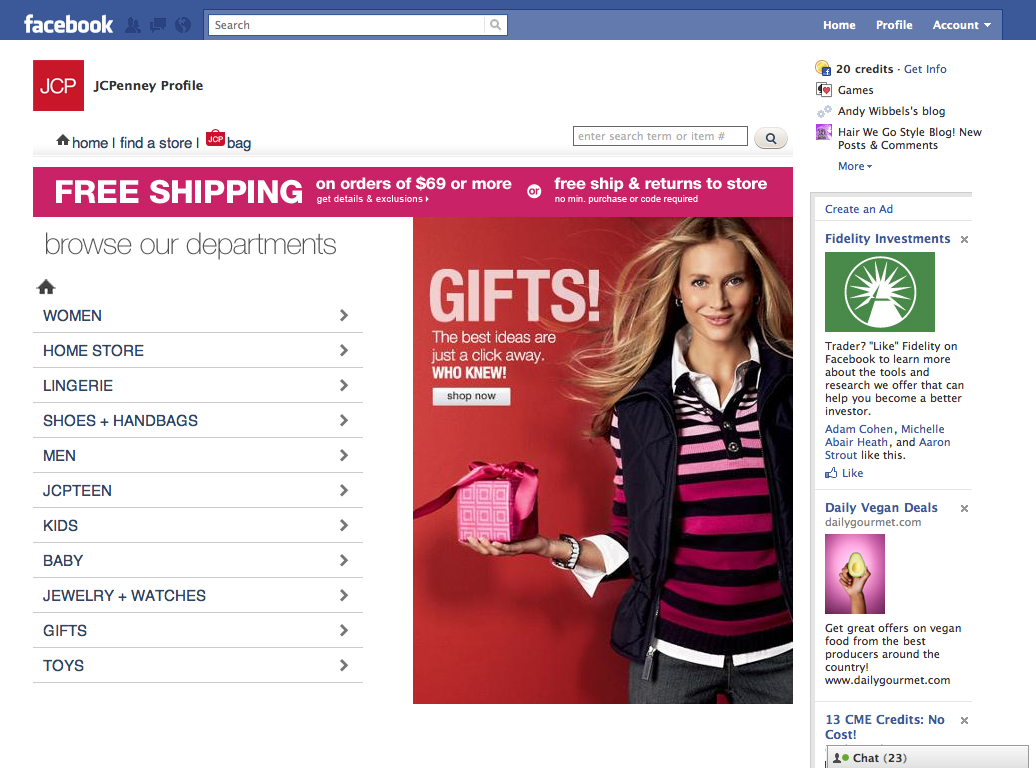
Landing Page of the new JCPenney Facebook Store application
When the user clicks on of the categories on the left, the app loads (via JQuery) new content representing the subcategories, on down to specific shelf page and then a product detail page, as you can see in this brief video:

The major problem with this approach is that the application never changes the top-most frame’s URL as the user navigates. Start on the landing page, drill down to Men, then to suits and sportcoats, then to a specific coat. Now, back up to the shelf page. D’oh! If you’re like me, your habit is to hit the back button in the browser (or even the keyboard shortcut for it), but if you do that here, you’re SOL. (If you’ve opened the store in a new tab or window, you may find your back button disabled, depending on your browser – but if the tab or window you are in has a history, back will take you to the last url you visited before entering the store).
The problem is that the app isn’t changing the original url you were on once you entered the store, so no new entries are created in your browser history. This was a problem with frames the first time around, and remains one with this approach. (Aside: in WPBook we handle this by targetting all links to top and creating fully formed apps.facebook.com/app/path style URLs).
Usability issues aside (and yes, there is breadcrumb / back navigation just below the top navigation – but it is easy to miss), my bigger issue with the application is just how non-integrated with Facebook it is. JC Penney doesn’t seem to be taking any advantage of the fact that I’m already logged in to Facebook and have granted the application all kinds of privileges in the process.
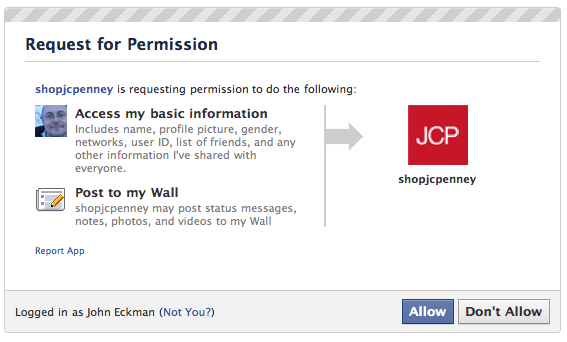
When you first load the application, you’ll get this permission screen:
Permissions Request for Shop JCPenney Application
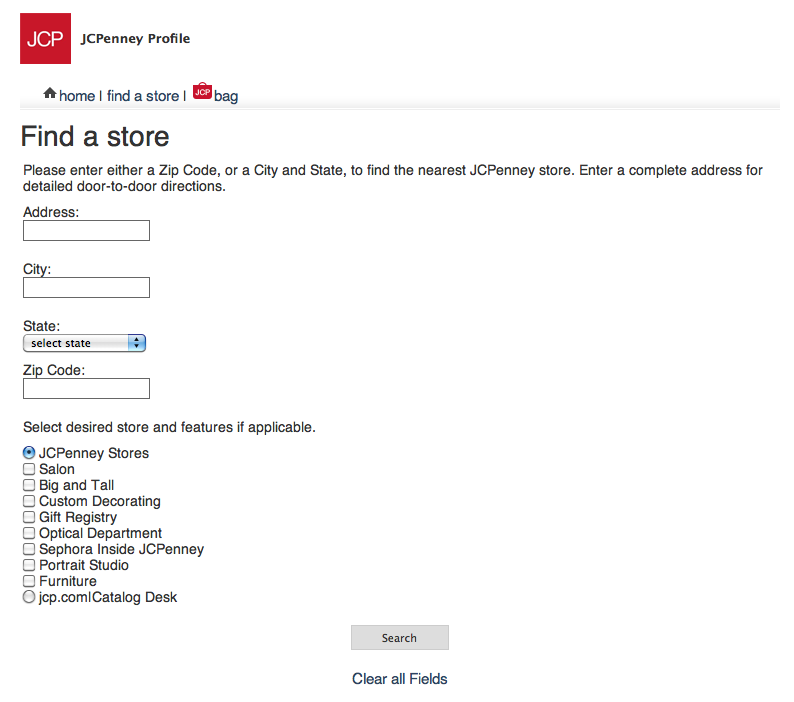
So you’ve granted the app permission to access your name, photo, gender, and “any other information I’ve shared with everyone” – which for most folks is a lot of other information. But then if I go to the “store locator” within the app, it doesn’t offer to use my location from my profile (or ask for the extended permission user_location, which an application can specifically request):
Store Finder inside Facebook - doesn't leverage user_location
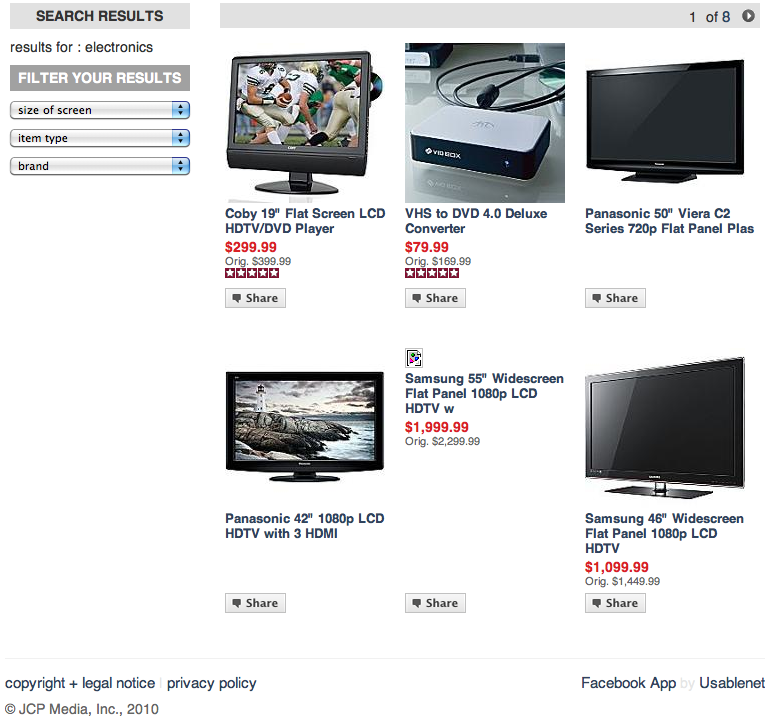
So maybe there isn’t much leverage in the store locator inside Facebook – or perhaps it might be better at that point to request the location from the browser rather than from Facebook. But the same lack of integration more glaringly comes up when you go to check out. For example, say I found an LCD TV I wanted to purchase. (The broken image icon in the screenshot occurs randomly throughout the app – seems to be something amiss with the translation into Facebook App in some cases):
Department page for House -> Electronics -> TV and Video
Clicking in to a TV, and adding it to my bag, I then proceeded to click on checkout, and get this screen:

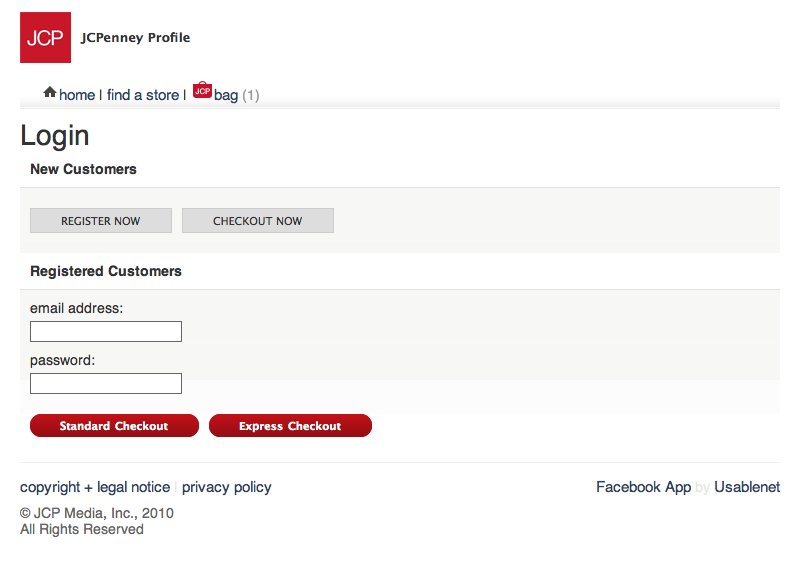
Checkout Process - No Prefilling with FB info?
Granted, the email address I used when registering at JC Penney’s may or may not match the one I used as primary at Facebook, so it is a good idea to not assume they are the same, but why not request my email from Facebook and prefill it for me, so that I don’t have to start from scratch? More to the point, why do I need to register at all? You can check out without registering, and the only difference seems to be associating an email address and password with the account. But given that I’m logged into Facebook and granted the application permission to access my info, why not just allow me to then use my Facebook identity to later access my account? Why do I need yet-another-password at all?
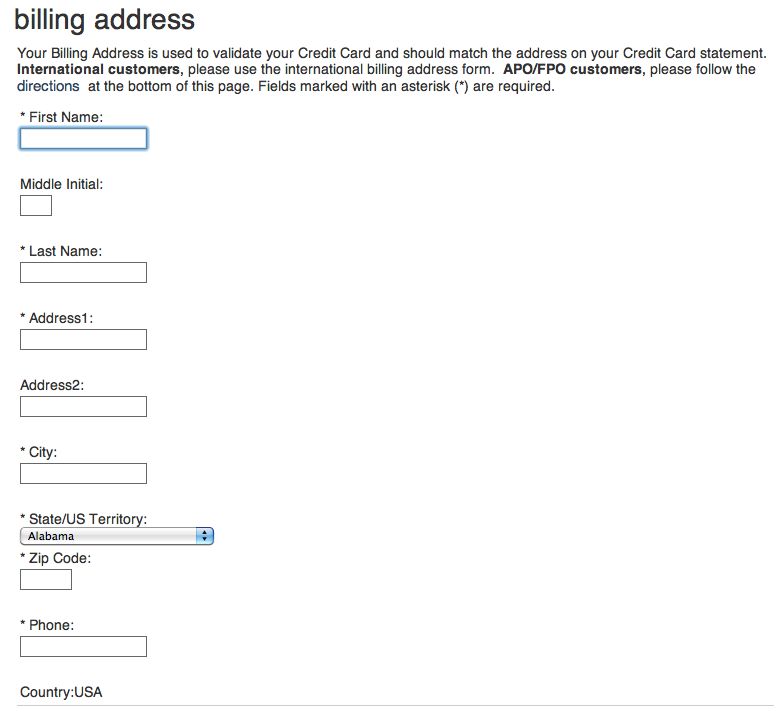
Assuming I didn’t already have an account at JC Penney’s, and clicked Register, I get this (after an initial screen for email and password):
Billing Address page for Checkout
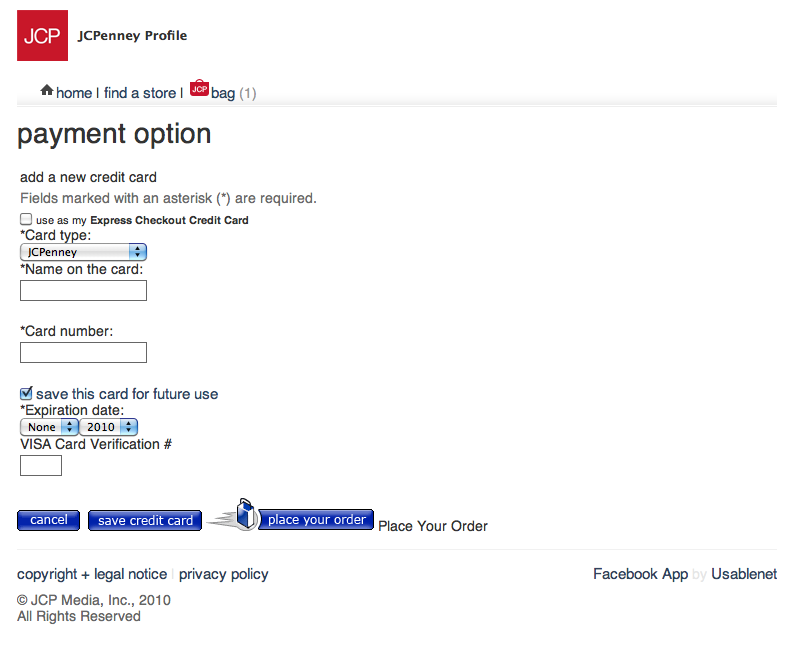
The only thing defaulted here is the USA, which I think is not because I’m in the USA but because it is the only allowed option. On to payment then, let’s use a credit card:

Credit Card Info
To me this feels very much like ecommerce circa 1999 – multistep checkout with a broken back button, no useful defaults (couldn’t we at least assume the name on the card might be usefully prefilled with the name I gave two screens ago? Editable, sure, but blank?), and changing look and feel – note that the buttons on the credit card screen are suddenly blue where they’ve been (somewhat) consistently red or grey.

E-commerce on FB? Currently e-tail experience is circa 1999. @jeckman#pisummit#gothammediaDec 21 via web
My larger point, though, isn’t just to critique the usability of the application. First to market doesn’t always mean best-to-market, and I’m sure the usablenet solution (which simply translates the existing store, requiring no significant platform effort on the retailer’s part) offers a compelling time-to-market advantage.
My point is that we need to question the very purpose of Facebook stores: Why is it supposed to be useful to me as a consumer to browse the entire catalog and make a purchase inside Facebook?
I get that retailers want to be where the audience is – and I’m a big proponent of distributing your digital footprint throughout the web. But what such stores fail to do is customize the experience to its context. What the user wants to do in Facebook is not the same as what the user wants to do on JCPenney.com, and (equally important) what the technology enables is different.
What retailers need to do in looking at Facebook as an opportunity is innovate: create opportunities for user experiences that take advantage of the Facebook ecosystem, both in terms of technology and user expectations. Just as mobile application developers have come to understand that what makes sense on a phone or a tablet isn’t exactly the same set of functionality that makes sense on a web application designed for desktop browser use, F-commerce developers and designers need to prioritize and understand that subset (or maybe it is a superset, entirely new) of functionality that makes sense in context.
We need, in other words, applications actually designed for use in Facebook, not more retailers putting their whole store in an iframe-based application just because they can. I think this is why virtual goods based applications have so far proven much more successful than real-world goods in Facebook: they’re native to the platform, and designed directly for it, not “adapted” to it.
Did you like this? Share it:
Related posts:
  1. Social as a Layer: Sears’ Social Commerce Experience
  2. Pecha Kucha Boston 4
  3. WordCamp NYC, WPBook, WordCamp Boston
  4. App Culture
  5. Facebook Changes, WPBook
 
 
1 Comment. Leave a comment or send a Trackback.
#1 • David Fishman said on December 28 2010:
 
John -
This is a great analysis. Very well thought out! The last paragraph really drives home your point.
“We need, in other words, applications actually designed for use in Facebook, not more retailers putting their whole store in an iframe-based application just because they can. I think this is why virtual goods based applications have so far proven much more successful than real-world goods in Facebook: they’re native to the platform, and designed directly for it, not “adapted” to it.”
I would appreciate it if you took a pass at our Facebook ecommerce appl.
http://apps.facebook.com/guessstylestudio/?ref=bookmarks&count=0