Saturday, June 11, 2011

About LiveJournal

This article highlights the popularity of Live Journal in Singapore in particular, and acknowledges how the software is used in large numbers for blogshops.

Although Blogspot is the number one platform for blogshops, Live Journal is the choice for prople who want to differentiate.

From: http://www.penn-olson.com/2011/06/08/tickled-live-journal/


Singaporean Company Tickled to Represent LiveJournal in Asia

livejournalMany of you probably remember LiveJournal as one of those early platforms where you first experimented with that strange new thing called of ‘blogging.’ Back in 2007 the Six Apart subsequently sold the company to Russian media organization SUP, its current owners.

Since then the service has evolved, as it describes itself as transitioning “from a journaling network into a vibrant, community-driven destination site.” It’s also transitioning geographically as well, now making inroads into Singapore, India, and South East Asia.

That brings us to today’s news that LiveJournal will be launching South-East Asian country portals, and has enlisted Singapore’s Tickled Media to represent it in the region. SUP’s CEO Annelies Van Den Belt explained the move in a statement:
Social media in Asia is experiencing tremendous growth and LiveJournal sees it as its next big market. Partnering with Tickled Media with their local online expertise and strong advertiser relationships offers LiveJournal the ideal platform to expand our presence and have a competitive edge in the region.
tickled mediaLiveJournal claims to attract over a million uniques in Singapore every month, which makes it the site’s fifth largest audience. Tickled Media tells us that the Philippines also represents the next largest number of viewers at 350,000 per month, while Indonesia is third at 200,000.

Tickled’s representative explained further that South East Asian nations primarily use LiveJournal for blogging, and users are distributed about evenly among males and females. That’s not the case in Singapore, however, where “it is predominantly used by females – aged between 16-30 to blog about fashion or run blogshops, sprees and online fleas.”

It remains to be seen whether LiveJournal can enjoy long-term success in Singapore and the rest of South East Asia, but it will be interesting to see how it adapts to suit regional markets.

Interview with a Singaporean teen blogshop owner

Blogshops in Singapore that are owned by teen share many of the same features as their adult own counterparts.  However, there are some interesting differences which are captured very well here.

1.  A lot of them are garage sale outlets to clear the owners' old clothes.

2.  The owner is trying to get rid of her old things so she can earn money to buy more of the things she like.

3. The main issues are hassles with customers (teens) who ask too many questions, who are late to meet ups, and who rip off their pictures, etc.

4. Many of them tend to be temporal; they close many times, and many move to new URLs.
 This means these blogshops are highly DISPOSABLE.

This interview was taken from: https://ctkathy.wordpress.com/2011/06/07/being-an-entrepreneur-interview-with-a-teenage-blogshop-owner/

Being An Entrepreneur: Interview With A Teenage Blogshop Owner

I interviewed a teenage blogshop owner, Rin Mitsuki, 17. The aim is to promote entrepreneurship among teenagers. :)


What is your blogshop name and what are you selling?
My blogshop is: http://303roses.blogspot.com
I sell second- hand clothes that are bought and worn once or twice, or not worn before.

Why did you start a blogshop?
I want to get rid of my stuff, out-dated clothes to earn extra income to have money to buy more new stuff.

How long do you have a blogshop?
I opened a blogshop since I was in Secondary 3 and has been changing blogshop ever since.

How do advertise your blogshop?
It is sort of automatic as there are these tags where links of blogshops are gathered for people to see.

What are the challenges that you face?
Well, some customers ask a lot of questions but in the end they did not buy anything.
Some blogshop owners will ‘steal’ pictures of the items that you took on your own from the blogshop and put it at their own blogshop.
It is also difficult to sell sometimes because there are cheaper prices that are offered elsewhere.

How do you overcome these challenges?
I would confront those who took my pictures without permission and leave it to settle. I will also imprint my blogshop name vividly on my pictures so that no one can take it anymore.
In terms of pricing, I did not change the prices of my items despite of the lack of customers as I feel that my prices are reasonable enough.

How much capital do you require to start the blogshop?
Erm…I need none at all.

How much do you earn?
For now, I am Missing In Action (MIA). However, I earned around $100-$200 at least ever since I started with blogshops.

What are you planning to do in the future?     
I will merge with a friend to re-create another blogshop in June and we will sell our clothes which are not worn before. Either selling at a cheap price, maybe $10, or do trades. People can trade their stuff with ours as long as it is reasonable.

Tuesday, May 17, 2011

UM's Wave 5: Impact of Social media on Malaysia

Here are a couple of articles that focus on Malaysia in the Universal McCann Wave 5 report:

 From: http://www.adoimagazine.com/newhome/index.php?option=com_content&view=article&id=6318&catid=1&Itemid=5


Social Media’s impact on consumers and brandsPDFPrintE-mail


(8 votes, average: 4.50 out of 5)
The fifth instalment of Universal McCann’s Wave research study confirmed that Malaysians used social networking sites such as Facebook, MySpace, and Twitter for making contacts for work, promoting yourself, and changing opinions.

The sample size of Wave 5 in West Malaysia was 500 respondents aged 15-54 years. Wave 5 is one of the world’s long-running examinations of the impact of social media on today’s global marketplace. 


Prashant Kumar

The Universal McCann research study, which has measured the scale and impact of social media since 2006 – the same year Facebook arrived to everyone over 13 years old with an email address – explores changes in communication technology and ways in which social media affects consumer habits.

According to the study, at least 50% of the respondents have discovered new brands through social networks.

“The research is extremely useful in identifying ways in which clients can utilise the social media landscape to engage and connect with consumers to drive sales,” believes Prashant Kumar, CEO, Universal McCann Malaysia.

The most significant shift in social media in recent years is the ability of users, particularly males of a higher socio-economic status, to engage via mobile devices. This finding demystifies the perception that social media is dominated by a younger demographic. Although 38% of social media users are in the 25-34 age bracket, the 35-44 age segment is fast catching up with 24% of them using social media actively.

“New conversation tools are emerging daily, and companies must leverage on these developments by saying something meaningful,” Kumar notes. “Even traditional media is shifting to digital. It is imperative that at a minimum, brands must invest in social listening.”

Socialisation of brands is a major shift in how brands are communicating with consumers. The Wave 5 study reveals that 80% of the respondents have visited an official company or brand website in the last six months.

“There is obviously a huge benefit to engaging consumers in the social space, but the challenge is to identify the type of social experience they want,” explains Kumar. “We must understand consumer needs before we can create compelling and successful social media programs.”

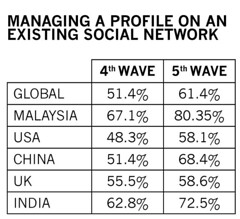
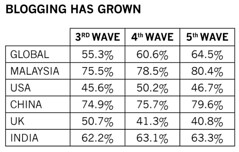
Despite a noticeable drop in Europe, blogging in Malaysia has grown from 75.5% in 2008 to 80.4% this year. The study also confirms that Malaysia ranks among the highest in the world in terms of managing a profile on an existing social network. Visiting friends on a social network page is the top social media activity along with watching videos online.


From: http://www.marketing-interactive.com/news/22965


The Social Life Of Brands

By: Staff Writer, Malaysia
Published: Nov 04, 2010
  • Wave 5 - social media is instrumental to consumer decisions formed
  • 50% of the respondents discover new brands via social networks
  • Malaysians use Facebook, Twitter & MySpace to better engage
Malaysia - Universal McCann's recent Wave 5 study has shown that the role of social media in relation to how Malaysians form decisions about brands has grown significantly. Consumers are heavily reliant on the platform for a variety of reasons.
Local customers utilize sites such as Facebook, MySpace, and Twitter to widen their pool of contacts for work, promote themselves and change or shape opinions. In West Malaysia, the study involved 500 respondents between the ages of 15 and 54.
Based on the data compiled, up to 50% of the respondents have uncovered new brands via social networks.
According to UM, the research exercise is one of the longest-running examinations of the impact of social media on today's global marketplace. The latest instalment served to explore the changes in communication technology and ways in which this element affects consumer habits. It measured trends as far back as 2006 until the present.
"The research is extremely useful in identifying ways in which clients can utilise the social media landscape to engage and connect with consumers to drive sales," said Prashant Kumar, CEO, Universal McCann Malaysia.
The most obvious shift in recent years is the ability of users (males of a higher socio-economic status), to engage using mobile devices - debunking the myth that social media is dominated by a younger demographic.
While 38% of social media users are in the 25-34 age bracket, the 35-44 age segment is fast catching up with 24% of them using social media actively.
Worldwide, Malaysia also ranks among the highest in terms of managing a profile on an existing social network. The study determined that the top social media activities are visiting friends on a social network page and watching videos online. 
 
Wave 5 also revealed that 80% of the respondents have visited an official company or brand website in the last six months.
"New conversation tools are emerging daily, and companies must leverage on these developments by saying something meaningful. Even traditional media is shifting to digital. It is imperative that at a minimum, brands invest in social listening," Kumar added.
Blogging in Malaysia has also grown from 75.5% in 2008 to 80.4% this year, despite a huge drop in Europe. 
"The challenge is to identify the type of social experience customers want. We must understand consumer needs before we can create compelling and successful social media programs," he noted. 

UM's Wave 5: Impact of Social media on Singapore

Here is an article related to the Wave 5 report, in relation to the impact of social media on Singapore:

From: http://www.adasiaonline.com/2010/10/um%E2%80%99s-wave-5-sheds-light-on-impact-of-social-media-on-consumers-brands-in-singapore/

UM’s Wave 5 Sheds Light on Impact of Social Media on Consumers, Brands in Singapore

Study background
Singapore, October 14, 2010 – UM today unveils findings from the fifth installment of its Wave study, one of the world’s largest and longest-running examinations on the impact of social media in today’s global marketplace. The UM study has measured the scale and impact of social media since 2006, the same year Facebook became the online destination for everyone over 13 with an email address. Wave 5 explores changes in communication technology as well as the ways in which social media influence consumer habits.
“We are very proud and excited about our Wave research because it is one of the largest global studies delving into the influence of social media. Year after year we continue to track the explosion of emerging technologies and uncover insights on how to harness these changes,” said Huw Griffiths, EVP and Global Director of Research and Analytics for UM. “This year, we feel we have incredible data on how brands can leverage social media to drive sales. We look forward to using the Wave 5 research to help our clients better engage and connect with their consumers.”
Conducted in July 2010, Wave 5 this year expanded to encompass 53 different countries, covering 85% of the world’s Internet population. 36,800 social networkers around the world also took part in the study. Just over 500 active Internet users in Singapore took part in the study (reflecting close to 2.1 million Singaporeans 16+). Importantly, the study allows us to identify local trends and cultural differences as well as similarities. The information gathered is a data goldmine for brands attempting to build stronger relationships with target consumers, giving UM a strategic advantage in accurately forecasting consumer behavior.
Local and global…
An immediate finding of the study is that social media platforms are now firmly ingrained in consumers’ everyday lives, with more people using these networks to connect with friends than even the telephone or email.
Perhaps the most significant shift in social media in recent years has been the ability of users to interact via mobile devices. Nearly 30% of mobile users now frequently access the Internet. Wave 5 reveals that smartphone users, who are primarily male and come from higher socio-economic brackets, frequently access social media sites, tearing down the perception that this medium is dominated by younger demographics.
Still, younger demographics engage more deeply with social media platforms, using them as one-stop shops for interacting with peers. From direct messaging to pictures and information sharing, everything is conducted in a single space. Tapping into that space is therefore increasingly more valuable to brands, with social media communities often proving to be more valuable than traditional brand websites.
“Having a social media presence is a crucial element of the marketing communications mix for brands these days,” said Jeannette Liendo, Global Director, Marketing Excellence, Microsoft. “Brands that aren’t prepared to interact with their target audience through these platforms will suffer. Recent advertising spend through what were traditional routes may be down overall, but digital activity, predominantly through social media, is on an upward trend.”
In fact, of those who joined a brand community, 72% said they felt more positively about the brand, 71% said they are more likely to buy the brand, 66% said they felt more loyal to the brand, and 63% said they recommended others to join. These figures clearly demonstrate that the “socialization of brands” is a major shift in how brands are communicating with consumers, and it is a trend that is likely to continue.
“The survey title, ‘The Socialisation Of Brands’, sums up the current landscape perfectly,” said Clinton Simpson, Managing Director, UM Singapore. “There is a huge benefit to brands that engage with consumers in the social space, but the challenge is to identify the type of social experience consumers actually want. Wave 5 demonstrates that a deep understanding of these consumer needs is the key to creating compelling and successful social media programs.”
Key Facts about Singapore from WAVE 5
Social networking is a form of mass media in Singapore
 Nearly 80% of active Singaporean internet users have managed their existing profile on a social network in the past six months, while around 52% have created a new profile during that same period
(a) Microblogging (Twitter) users have more than tripled in last 12 months
(b) 64% of Singaporeans message friends over social networks
(c) 61% of Singaporeans upload photos to their social network profile
 Contrary to the declining global trend a large number of Singaporeans are still visiting company/brand websites almost 8 out of 10, 74 per cent find them very influential
Changing the way we use social networks
 The gap between young and old age groups in terms of social network usage is narrowing
(a) On a year-on-year basis, the 45 – 54 year-old age group has nearly tripled their social network penetration based on the number of people in this group who actively manage their social network profile
 We are also seeing a gravitational pull to do more and more of other online activities within our own community and chosen host network
(a) Upload videos
(b) Organizing events, etc.
Singaporeans are mature internet users
 Singaporeans are more worried than their global peers on missing out if they don’t regularly visit their social network profile
 More than 50% think social networking sites are an integral part of social life
 Less likely to think more positively about companies that have blogs or to trust bloggers who blog about products and services, partially due to the fact that they realize just about anyone can write a blog
 Though nearly 36% like personalized adverts online, this is still well behind the global average
 Much more likely to join a brand community online (53% did) and some of the strongest reasons for doing so are:
(a) Support a cause they like
(b) Get advance news on products. We like to stay ahead of the curve.
(c) Get free content – free is always welcome here!
(d) Learn more about the brand
 When it comes to finding advertising influential, Singaporeans put in-person recommendations first, be it from an expert or a friend
(a) TV commercials come next
(b) Recommendations from a social network friend or a retail site feature in the top 10 influential sources
(c) Reflection of the fact that we Singaporeans lean the most on advice from “tried and tested” sources
 Singaporeans are willingly seeking social networks to connect with brands with 53 per cent joining an online brand community and 38 per cent already a fan of a brand
 Interestingly, almost half of the people we surveyed discovered brands through social networking sites.  User activity on these sites is not confined to connecting with known brands
To see more specifics on the findings of the study, please see the full Wave 5 report at http://www.umww.com/wave5
Click image to view pdf


McCann Wave 5 Report 2011

Here is the 2011 Universal-McCann Wave 5 report that tracks development in social media usage across the globe.  This edition of the report is called Socialization of Brands, which focuses on the impact of social media (including blogs) on commerce.

http://www.universalmedia.nl/files/Wave_5-The_Socialisation_Of_Brands-Report.pdf

This is another version, with editorials:
http://www.ecr-baltic.org/f/K.Gedrovics_The_Socialization_of_Brands.pdf

Wednesday, May 11, 2011

How Shopaholics created the blogshop universe

This blogshop review blog explains how shopaholics have created the blogshop universe.

Blogshops emerged because fashion conscious individuals (fashionistas) discover gaps in the local fashion scene and opportunities for them to become sellers.

Blogshops need to be linked and found by others, so other individuals step in and fill a variety ofrelated online shopping needs.  In this blog, the owner decided to become a reviewer, as well as to provide links to blogshops.

Thus, owning a blogshop is only one way to participate in the fashion hobby.  You can also provide blogshop reviews, a site that lists blogshops (directory), and a variety of otherroles that support blogshops.

http://diaryofane-shopaholic.blogspot.com/

In The Beginning..

There was a girl.
There were online boutiques.
A medium did not exist to connect her with all these online boutiques with a single click.

Hence, she decided to create a blog specially for girls just like her :)
To be able to connect with all the online boutiques via one medium.
For comfort;
For ease;
For convenience.

To make online shopping a breeze.

And Then..

She thought there must be more than just collecting the links of online boutiques.

And so, this online shopaholic decided to review items daily as well as highlight pieces of clothing or accessories (bags & belts) or shoes she oh-so-loves!

Last of all, she does hope that you will enjoy your stay here :)

To owners of online boutiques:
Drop her a mail if she hasn't linked you yet, or to inform her of updates.

To shoppers:
At this site, you'll be able to find everything you need about online shopping ;)
From latest updates, to over three hundred links to local online boutiques!
Everything you need, one place, one stop ;D
Updates at your fingertips!

Monday, April 25, 2011

Malaysian Consumers are Spending More Online! RM1.8 billion Spent in 2010


This piece of news confirms my suspicion that blogshops are opening up online shopping to the masses.

Where previous studies have claimed that Malaysia shoppers have been reluctant to buy online, things have been changing quite rapidly. 

From: http://www.mofew.com.my/2011/malaysian-consumers-are-spending-more-online-rm1-8-billion-spent-in-2010/ 

A recent report revealed that Malaysians spent RM1.8 billion in online shopping last year, which marked a 3x increase compared to reports 3 years ago. Although half of the amount goes towards travel and bill payments, this also comes in as good news.

What does this mean to online fashion entrepreneurs?

1. Increased Customer Confidence in Online Purchases

Customers are opening up to the idea of online shopping. The usual excuses of being skeptical of the products, security threats or not knowing how-to is on a decline. Although security issues (e.g. payment) is still a concern but it is good to know that they are still willing to purchase (RM181 million comes from Fashion and Beauty alone)!

2. More Opportunities for New Online Fashion Entrepreneurs

The cake is growing in size thus allowing newer entrepreneurs to be a part of it and the only limitation is creativity. Whether it is handmade products, self designed apparels, handbags or accessories, there is room for all and this is a great year to get started!

3. It is Time to Step Up Your Game

More entrepreneurs also means that competition will be stiffer than ever and online entrepreneurs will have to compete beyond just price, quality and service. It comes also comes down to various online marketing strategies using Search Engine Optimization (SEO), social media, videos and more to stand out from the rest.

Moving Forward

These are exciting times for every online fashion entrepreneurs and aspiring ones and MOFEW is proud to be able to be a part of introducing Malaysian online fashion entrepreneurs to the consumers. Looking forward to an awesome year for the online fashion industry in Malaysia! :)